From the cowshed to over 50 employees: The story of puralpina
A converted cowshed. A pot of mulled wine. An ointment. That was all it took in the beginning.
Well, it probably wasn't quite that simple. But back in the early 1990s, there was no talk of a company with over 50 employees, its own manufacturing facility, and an extension. Actually, building a large company was never the declared goal. There were no target sizes, no desired number of employees, and no sales figures that needed to be reached at some point.
The only thing there was: an idea, the conviction to turn it into a good product, and always keeping up with the spirit of the times.

All because of a bottle of marmot oil
The story began even before 1992. Andreas Schmid had been working with marmot oil for several years. His father-in-law suffered from severe joint problems at the time, and a bottle of warm marmot oil was always kept ready on the stove. He would say it was the only thing that still helped him.
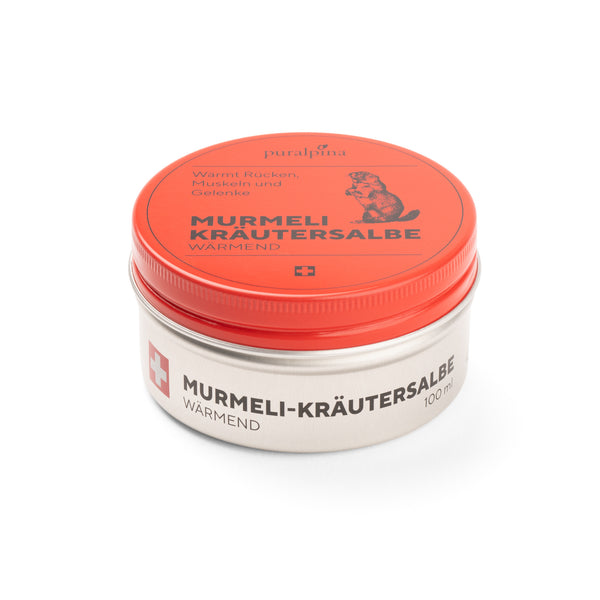
A sentence that stuck with Andreas Schmid. He tinkered and continued to develop it. In 1992, the first warming Murmeli herbal ointment was created.
Even back then, a trait emerged that has run through our company history to this day: stubbornness. Artificial bases and additives were out of the question for Andreas, even when experts recommended otherwise. As a hunter, it was also important to Andreas "Dresi" Schmid to make sensible use of as many parts of a harvested animal as possible. He also wanted to stay as close to nature as possible in the manufacture of his products.
Back then, that might have been a bit stubborn. Today, it is our fundamental philosophy.
Then we'll just do it ourselves
Production took place wherever there was space: in a converted cowshed in Frutigen. The cows, incidentally, had moved out long ago. There was no high-tech equipment, but there was a mulled wine pot. That was where the first salves were created, filled and labeled by hand.
And not just by Andreas. puralpina quickly became a family affair. Above all, "Dresi's" wife helped out a lot. And so it happened that the three sons sometimes had to help with the labeling.
Reto, the youngest of the three brothers, remembers how ten boxes of salve would be waiting at home to be labeled, and they would label them while watching TV. What had to be labeled, had to be labeled. Even if, as a boy, you would have preferred to be outside playing soccer.
That these salves would one day be part of their professional future was something Reto and Silvan would not have believed back then.
«Not in a million years.»
Take over puralpina? No, not in a million years. After school, Reto completed a commercial apprenticeship at a bank, stayed there, and initially saw his future in that world. A banker instead of a salve maker—it actually seemed pretty clear-cut.
As fate sometimes has very different plans, Reto was drawn away from banking and toward marketing. However, the bank didn't offer him the opportunities in marketing that appealed to him. And suddenly, there was an idea that had hardly been one before: Why not work for my father? Reto joined puralpina in 2007. Not to take over the family business one day. Simply to help out and be allowed to do marketing. It was only when Silvan suddenly joined the company as well that something changed. Suddenly there were two of them, and a thought that had barely existed slowly turned into a real possibility.
Why not, actually?
The brothers brought different strengths to the table. Reto was drawn to experimenting and creating. Silvan contributed more from an entrepreneurial and strategic perspective. Two points of view on the same company and, perhaps precisely for that reason, a pretty good combination.
"We never had to think exactly alike. What was more important was that we knew where we wanted to go together. Our different strengths probably helped us more than they hindered us in the process."
– Silvan Schmid
The handover did not happen with a clean break, but step by step. In 2012, the next generation officially became the future of puralpina.

Delegate responsibility
Building your own company takes courage. Handing it over at some point probably takes even more. Andreas was 64 at the time and was capable of something many founders struggle with: letting go.
Of course, he still had an opinion and wasn't afraid to share it. But he also trusted his sons to make their own decisions, offered support in an advisory role, and didn't need to control everything himself.
Suddenly there were no longer three or four
puralpina grew, not explosively and not according to a master plan, but step by step. Looking back, Reto describes the time when three or four people did practically everything themselves as intense. You couldn't just pass anything on to the relevant department, because you were usually the relevant department yourself. Production, sales, decisions, problems, ideas: everything rested on a few shoulders.
That changed with growth. Tasks could suddenly be distributed, new people joined. The small business gradually became a company. It still wasn't always easy. Looking back, they could have invested earlier in some areas, hired people faster, or been braver. But taking big risks was never part of puralpina's DNA.
Or, as Reto describes it:
"We probably reacted more than we worked according to a plan with big goals."
Surprisingly, a lot of it worked out.

From mulled wine pot to manufactory
Until 2016, 24 years after the first marmot herbal ointment, production actually still took place in a converted cowshed. Then there was no longer enough space, and production moved to the new manufactory in Vorderhasli. The mulled wine pot became professional equipment, one ointment turned into an entire range, and a few helping hands turned into many more.
What remained is the way we produce: still in Frutigen, still with a lot of manual work, and still with the commitment to manufacture natural products without artificial additives.
"Of course, puralpina is a different company today than it was 30 years ago. It has to be. But for us, growth only makes sense if we don't lose what defines us in the process."
– Silvan Schmid
And now?
Today, over 50 people work at puralpina. With the expansion building in 2026, significantly more space for production, warehousing, and logistics has been added. Where once one person started with an idea, responsibility is now shared among many shoulders.
Could the family have imagined this in the early 1990s? Hardly. Today, Reto sometimes walks through the facility in amazement. Proud? Of course. But walking through the hall and thinking, “Look at everything we’ve built here”? That doesn’t quite fit.
Because size was never the goal. It was about making a difference, creating good products, trying things out, and moving forward when the next step was necessary. Stagnation was never an option for the entire company.
Or, as Reto puts it more directly: “Inertia in a company is death.”
And so, a bottle of marmot oil turned into an ointment, the ointment into a small business, that into a family company, and a converted cowshed into a manufacturing facility with over 50 employees.
None of this was ever planned. It’s wonderful that it happened anyway.
Our Bestsellers